

Table of Contents
I went looking for the “Do Not Send Voice Recordings” setting on my own Alexa app while researching smart home privacy for this piece, certain I’d toggled it on years ago. It’s gone. Amazon quietly discontinued that option on March 28, 2025, ahead of the Alexa+ rollout, every user who had it enabled had it automatically revoked, whether they noticed or not. That single change is a good entry point into this whole topic: smart home privacy isn’t a fixed set of facts you learn once; it’s a moving target that occasionally moves backwards without much warning.
This article is about what your smart speakers, cameras, and hubs are actually doing with what they hear and see, not vague unease about “always listening,” but the specific, documented mechanics, incidents, and settings that make up real smart home privacy as of mid-2026.
Why Smart Home Privacy Matters More in 2026
Smart home privacy used to be a niche concern for early adopters. By 2026, it’s a mainstream question: voice assistants, connected cameras, and smart hubs have moved from novelty purchases to common household fixtures, which means the settings covered in this article affect far more than a small group of enthusiasts. Understanding what your devices actually capture, store, and share is the foundation of any real smart-home privacy strategy, and it starts with the technical basics outlined below.
How Voice Assistants Listen: The Technical Reality
Every mainstream smart speaker uses the same basic architecture: a small, low-power chip continuously listens for a specific wake word (“Alexa,” “Hey Google,” “Hey Siri”) using on-device processing. Nothing is sent anywhere until that wake word is detected — in theory, the device is listening locally but not transmitting until triggered.
In practice, this system isn’t perfect. False activations occur when background noise closely resembles a wake word, triggering it and sending a snippet of audio to the cloud that was never meant to be captured. This is a real, acknowledged limitation across every major platform, not a conspiracy theory, it’s the direct mechanism behind one of the most-cited incidents in this space: in 2018, a Portland, Oregon couple’s Echo recorded a private conversation and sent it to a random contact in their address book. Amazon confirmed the incident, attributing it to a chain of misheard commands, the device apparently misheard something as “Alexa,” then continued misinterpreting subsequent conversation as messaging instructions.
Read More: Best Free Password Managers in 2026 Compared: Secure Picks
The Amazon Alexa+ Change Nobody Talked About Enough
This is worth its own section because it’s recent, significant, and got less coverage than it deserved. For years, Alexa users had the option to enable “Do Not Send Voice Recordings”, a setting that processed requests without retaining the audio in the cloud. On March 28, 2025, Amazon discontinued that option entirely as part of the transition to its more AI-capable Alexa+ assistant.
Users who had the setting enabled had it automatically switched off; going forward, voice recordings are processed in the cloud by default, with no fully local-only alternative offered. Amazon’s stated position is that it deletes recordings once processing is complete, but the meaningful point is that the choice to avoid cloud processing entirely, which existed for years, no longer does.
This matters beyond Alexa specifically: it’s a real example of a privacy control being removed rather than added, which is worth knowing given how often “smart home privacy” advice assumes settings are stable once you have configured them.
When Human Reviewers Are in the Loop
All three major voice assistant providers have confirmed, at different points, that human contractors listen to a portion of voice recordings typically framed as quality assurance to improve recognition accuracy. This isn’t speculation; each instance below is a documented, reported event:
- Amazon: A 2019 Bloomberg investigation revealed that Amazon employed thousands of contractors globally who listened to Alexa recordings, including some that captured what workers described as potential crimes, intimate moments, and financial information.
- Google: In 2019, a contractor leaked more than 1,000 Google Assistant recordings to a Belgian broadcaster (VRT NWS), which was able to identify individuals and sensitive personal details from the leaked audio.
- Apple: Also in 2019, a whistleblower revealed that Apple contractors regularly heard confidential medical information, drug deals, and recordings of couples having sex, captured accidentally through Siri activations. Apple paused its human review program shortly after and made it opt-in going forward.
All three companies have since introduced explicit opt-out toggles for human review specifically, separate from the general voice-recording settings, a direct response to this reporting.
What It Cost Amazon: FTC Penalties
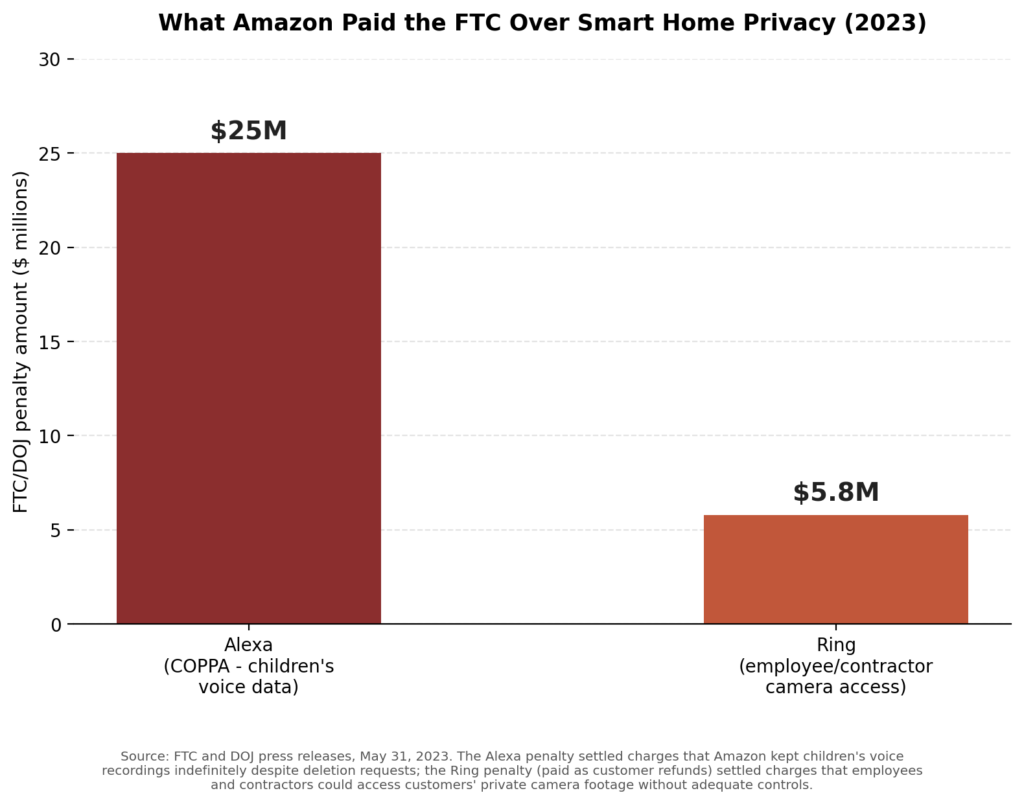
Beyond media investigations, regulators have taken formal action. In May 2023, the FTC and Department of Justice reached two significant settlements with Amazon in the same announcement:
Source: FTC and DOJ press releases, May 31, 2023.
Amazon paid a $25 million civil penalty to settle charges that it violated the Children’s Online Privacy Protection Act (COPPA) by retaining children’s Alexa voice recordings indefinitely and failing to honor parents’ deletion requests: the FTC’s complaint specifically noted that Amazon used the unlawfully retained recordings to help train its Alexa algorithm to better understand children’s speech patterns, benefiting the product at the expense of the privacy promises made to parents.
Separately, Amazon paid $5.8 million in customer refunds over Ring, its home security camera subsidiary, after the FTC alleged that Ring employees and contractors had broad, poorly controlled access to customers’ private camera footage, and that inadequate security practices had allowed hackers to compromise customer accounts and cameras in some cases.
Both settlements required Amazon to overhaul its data deletion practices and implement stricter internal privacy safeguards going forward, this wasn’t a symbolic fine; it came with binding operational requirements.
Smart Home Privacy Settings: Voice Assistants Compared
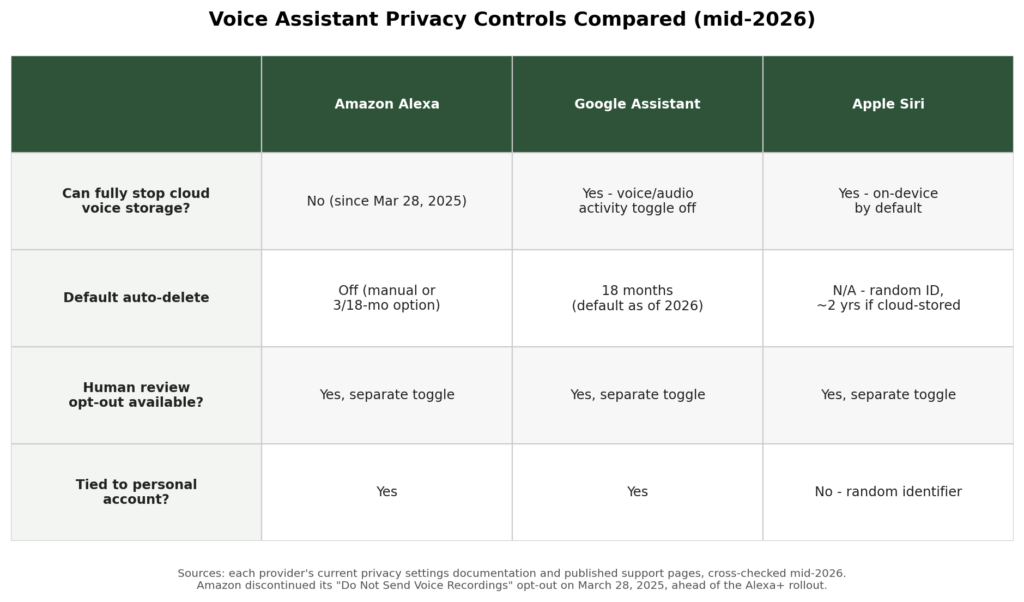
Here’s how the three major platforms actually handle voice data and smart home privacy controls as of mid-2026:
| Amazon Alexa | Google Assistant | Apple Siri | |
|---|---|---|---|
| Can fully stop cloud voice storage? | No, since March 28, 2025 | Yes – voice/audio activity toggle | Yes – on-device processing by default |
| Default auto-delete | Off by default (manual deletion or optional 3/18-month auto-delete) | 18 months (current default) | N/A – tied to a random identifier, not manual deletion in the same sense |
| Human review opt-out available? | Yes, separate toggle (“Help Improve Alexa”) | Yes, separate toggle | Yes, separate toggle (“Improve Siri & Dictation”) |
| Tied to your personal account? | Yes | Yes | No – associated with a random identifier rather than your Apple ID |
Apple’s architecture is the most structurally privacy-protective of the three, mainly because more processing happens on-device and stored data isn’t directly tied to your identity. That said, “most private of three cloud-connected assistants” is a relative claim, not an absolute one, Siri still sends data to Apple’s servers for many requests, and the random-identifier model, while better than direct account association, isn’t the same as full anonymity.
Pros and Cons of Each Platform
Amazon Alexa
- Pros: The most granular deletion controls of the three (you can filter and delete by device, useful in shared households); broad third-party device compatibility
- Cons: No longer offers a full cloud-storage opt-out; the platform with the largest confirmed FTC penalty in this space; historically the most contractor-reviewed recordings reported
Google Assistant / Nest
Cons and pros are more balanced: genuinely improved default retention (18-month auto-delete, down from indefinite in earlier years) and a real voice/audio activity toggle, but Google’s broader advertising business model means voice-adjacent data can intersect with a much larger personal data profile than either competitor maintains
Apple Siri
- Pros: On-device processing by default for many requests; not tied to your personal Apple ID; a stated policy against using voice data for advertising
- Cons: Historically the most restrictive about giving users visibility into exactly what’s stored (per user reports, there’s comparatively little to review or export compared to Alexa’s dashboard); smart home ecosystem (HomeKit) is smaller, so this privacy advantage doesn’t help much if you have Alexa- or Google-compatible smart home hardware already
Checklist: How to Lock It Down
A practical checklist, not vague advice:
- Alexa: Alexa Privacy – Manage Your Alexa Data – turn off “Help Improve Alexa” (stops human review); set auto-delete to 3 months rather than leaving it off; use the physical mute button on shared-space devices when not actively in use
- Google Assistant: Google app – Settings – Google Assistant – Activity – turn off “Include audio recordings”; set up 3-month auto-delete at myactivity.google.com; say “Hey Google, turn on guest mode” for temporary privacy in shared spaces
- Siri: Settings – Siri – toggle off “Listen for Hey Siri” if you want to disable always-on listening entirely; Settings – Privacy – Analytics – turn off “Improve Siri & Dictation” to opt out of human review
- All platforms: Review and delete existing voice history periodically rather than assuming a one-time settings change retroactively removes past recordings: changing a setting going forward usually doesn’t delete what’s already stored
For anyone who wants to avoid cloud processing entirely, offline-first alternatives exist: Home Assistant Voice and similar open-source projects process commands locally with no cloud dependency by design. The trade-off is real: less polished voice recognition and a steeper setup process than a plug-and-play Echo or Nest device, which is why these remain a niche choice rather than a mainstream one.
Smart Cameras and Doorbells: A Different Kind of Listening
The Ring settlement above is a reminder that “smart home privacy” isn’t only about voice assistants: connected cameras and doorbells introduce the same fundamental question (who can access what your devices capture, and under what controls) applied to video and audio simultaneously.
The FTC’s Ring complaint specifically centred on inadequate access controls that let far more employees and contractors view customer footage than was reasonably necessary, alongside security failures that allowed account compromises. The practical lesson carries over directly: enabling two-factor authentication on any connected camera account, and periodically reviewing which third parties or family members have shared access matters as much as the voice-assistant settings above.
Final Thoughts
None of this is an argument for ripping every smart device out of your home: the convenience is real, and for the large majority of interactions, nothing sensitive is ever reviewed by anyone. But smart home privacy is a genuinely moving target: Amazon removing a years-old opt-out in 2025, three separate companies confirming human review programs in 2019, and a combined $30.8 million in FTC penalties in a single 2023 announcement are all specific, documented reasons to treat default settings as a starting point to adjust, not a finished decision to forget about.
FAQs: Smart Home Privacy: What Your Devices Are Actually Listening To
What is smart home privacy and why does it matter?
Smart home privacy refers to how connected devices, voice assistants, cameras, and hubs collect, store, and share what they see and hear, and what control you actually have over that data. It matters because, as documented in this article, defaults can change without much warning (like Amazon’s 2025 opt-out removal), and real incidents have shown recordings reaching human reviewers or, in rare cases, the wrong contact entirely.
Can I still stop Amazon from storing my Alexa voice recordings in the cloud?
Not entirely, as of March 28, 2025L Amazon discontinued the “Do Not Send Voice Recordings” setting ahead of the Alexa+ rollout. You can still opt out of human review and set auto-delete periods, but full cloud avoidance is no longer offered.
Have voice assistant companies actually had employees listen to real recordings?
Yes, confirmed by all three major providers at different points: a 2019 Bloomberg investigation into Amazon, a 2019 contractor leak involving Google recordings (reported by VRT NWS), and a 2019 whistleblower account involving Apple contractors. All three companies added opt-out controls for human review in response.
Which voice assistant is actually the most private?
Apple’s Siri has the most privacy-protective architecture of the three mainstream options: more on-device processing and data tied to a random identifier rather than your personal account, but it’s a relative advantage, not full anonymity, and its smart home ecosystem is smaller than Alexa’s or Google’s.
Has any smart home company been fined for privacy violations?
Yes. In May 2023, Amazon paid a combined $30.8 million to settle two separate FTC/DOJ actions: $25 million over Alexa’s handling of children’s voice recordings under COPPA, and $5.8 million in customer refunds over Ring’s camera access controls.
About the Author
Emily Carter is a freelance writer and digital productivity researcher based in the United States. Over the past four years, she’s tested and written about the tools, apps, and platforms that freelancers and remote workers rely on daily, from security software like password managers to the AI tools and side-income platforms that make up the modern freelance toolkit. She writes from firsthand use, not press releases.

