
Table of Contents
Most “tech trends to watch” articles are written as if the year in the title hasn’t happened yet. I wanted to do something different: write this in July 2026, looking at what’s actually shipped, been measured, and happened, not what a press release predicted it might. Some of it lines up with the hype. A lot of it doesn’t, and the gap between the two is usually more interesting than either extreme.
Top Future Tech Trends in 2026
1. Generative AI Matures Beyond Text
Generative AI‘s move into video is the clearest example of real, measurable progress this year. OpenAI released Sora 2 on September 30, 2025, adding native synchronised audio and noticeably more physically plausible motion than earlier video models, but the Sora consumer app itself was shut down on April 26, 2026, with the underlying API scheduled to sunset entirely on September 24, 2026. Google’s competing model, Veo 3.1, has been stable since October 2025 and remains available through the Gemini API and Vertex AI. On May 19, 2026, Google added a new multimodal model, Gemini Omni Flash, free for YouTube Shorts creators, a launch that closed the gap left by Sora’s consumer shutdown within about three weeks.
Read More: Online Work Scams to Avoid in 2026
AI Video Generation: Real Pricing, Not Hype
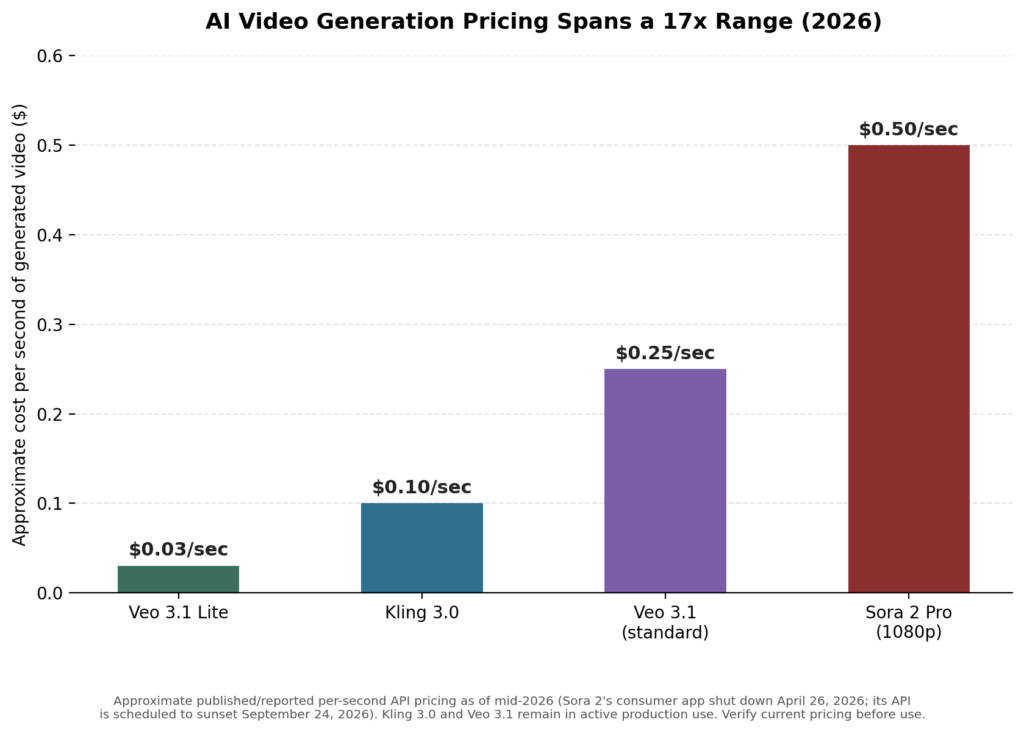
| Model | Maker | Native Audio | Approx. Price/Second | Status (mid-2026) |
|---|---|---|---|---|
| Veo 3.1 Lite | Google DeepMind | Yes | ~$0.03 | Active |
| Kling 3.0 | Kuaishou | Yes | ~$0.10 | Active, native 4K |
| Veo 3.1 (standard) | Google DeepMind | Yes | ~$0.25 | Active, leads on photorealism |
| Sora 2 Pro (1080p) | OpenAI | No (as of mid-2026) | ~$0.50 | API sunsetting Sept 24, 2026 |
The honest takeaway: “AI can make video now” undersells what changed. The bigger shift is that four of six major video models generate synchronised audio in a single pass, something that didn’t exist in any production tool as recently as early 2025. What hasn’t changed as much: long, fully coherent multi-shot narratives are still difficult across every model in this category, and vendor claims about which model is “best” are self-reported rather than independently benchmarked.
2. Extended Reality (AR & VR) for Work and Play
This is the trend where the honest 2026 story is very different from the “AR meeting rooms will be as common as physical ones” framing that circulated a couple of years ago. It hasn’t happened, and the shipment data explains why.
XR Headsets: Price vs. Actual Adoption
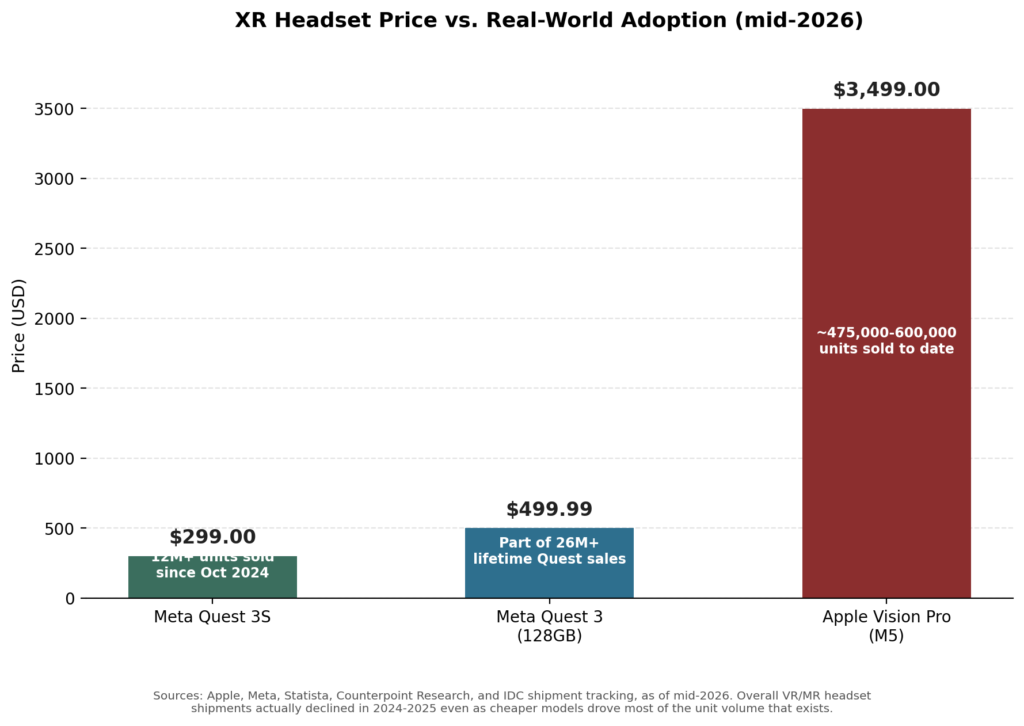
Apple’s Vision Pro launched at $3,499 in February 2024 and received an M5 chip refresh in October 2025, Apple kept the price unchanged. By mid-2026, cumulative sales sit somewhere between 475,000 and 600,000 units, generating roughly $1.66 billion in hardware revenue. That’s a real, sustained niche product, not the mainstream breakthrough some 2024 coverage implied.
Meta’s approach has been the opposite: the Quest 3S launched at $299 in October 2024 and had sold more than 12 million units by early 2026, while Meta holds somewhere between 75% and 84% of total XR shipment volume depending on the quarter. And yet overall VR/MR headset shipments declined roughly 12% year-over-year in 2024, and were projected to fall further in 2025 even as Meta’s cheaper models captured a larger share of a shrinking pie. Meanwhile, smart glasses (like Ray-Ban Meta) outsold VR/MR headsets by roughly 3-to-1 in 2025, and Ray-Ban Meta hardware revenue passed Quest hardware revenue for the first time that same year.
XR for entertainment and light AR use is growing through smart glasses, not headsets. Full VR/MR headsets remain a genuine niche, concentrated in enterprise training, high-end real estate sales visualisation, and gaming, not the everyday “virtual meeting room” use case that gets predicted every year. Meta’s Reality Labs division, which houses this entire effort, posted an operating loss of more than $16 billion in 2023 alone, a trend that continued into subsequent years, a useful reminder that “widely covered” and “commercially proven” aren’t the same thing yet.
3. Quantum Computing Will Become A Reality

Quantum computing had real, verifiable milestones in 2025, but “will become a reality” oversells where the technology stands today, and it’s worth being precise about the difference.
Google’s Willow chip (announced December 2024, 105 superconducting qubits) demonstrated ‘below-threshold’ error correction. In October 2025, Google announced a follow-up ‘Quantum Echoes’ experiment on Willow, claiming the first-ever verifiable quantum advantage, a computation it says ran roughly 13,000 times faster than the best classical simulation could reproduce it.
It’s worth noting Google has been here before: its 2019 ‘quantum supremacy’ claim on the earlier Sycamore chip was publicly disputed by IBM, which argued the same task could be simulated classically in about 2.5 days rather than the 10,000 years Google claimed. That earlier dispute is useful context regardless; it’s a reminder that even genuine milestones in this field tend to get contested, and ‘verifiable’ claims are worth watching for a similar response before treating them as settled.
Fujitsu and RIKEN announced a 256-qubit system in April 2025 with plans for a 1,000-qubit machine by 2026. Across the industry, leading systems currently run somewhere between 100 and 1,000 physical qubits, but researchers estimate that a genuinely fault-tolerant machine may require processors with tens of thousands to millions of physical qubits, a scale current hardware doesn’t come close to.
4. 5G Networks and Preparations for 6G Technologies
5G-Advanced continues rolling out globally, but “preparing for 6G” needs a specific timeline attached to mean anything. The ITU-R approved the IMT-2030 framework (the formal name for what the industry calls “6G”) back in 2023. As of 2026, the standards process is still in its requirements-and-evaluation phase, targeted for completion by the end of this year. The first concrete 6G technical specifications, produced through 3GPP’s Release 21, aren’t expected until roughly 2029, with commercial 6G deployment targeted for around 2030, a full four years from now, not an imminent rollout.
5. Innovations in Sustainable/Green Technologies
This is the trend with the clearest, most measurable 2026 data behind it. According to the IEA’s World Energy Investment 2026 report, global energy investment is projected to reach $3.4 trillion this year, and for the first time, clean energy investment (renewables, nuclear, grids, storage, efficiency, and electrification) is capturing nearly twice as much capital as fossil fuels.
Where the Money Is Actually Going

Roughly $2.2 trillion is projected to flow into clean energy this year, compared to about $1.2 trillion into oil, gas, and coal combined. Within that clean energy figure: renewable power investment alone is projected to be around $665 billion (with $365 billion of that in solar specifically), grid investment is set to approach $550 billion, and battery storage investment is projected to exceed $100 billion for the first time. Notably, coal investment is also still rising in absolute terms, projected at $180 billion in 2026, the highest level since 2012, with China accounting for roughly 70% of that global spending, a reminder that the clean energy shift is a relative majority trend, not a fossil-fuel phase-out that’s already complete.
How These Trends Will Shape Daily Life
Tying these together, the pattern that stands out most in 2026 isn’t any single breakthrough, it’s the gap between headline-stage announcements and what’s actually reached everyday use. Generative AI video tools have moved fastest, genuinely changing how quickly small teams can produce marketing and social content. XR remains a real but narrow niche, concentrated in specific enterprise and gaming use cases rather than daily life broadly. Quantum computing and 6G are both real, well-funded, multi-year efforts that are earlier in their timeline than casual coverage implies. Clean energy investment is the trend furthest along in actually reshaping infrastructure people rely on, simply because it’s backed by the largest, most immediate capital flows of anything on this list.
For anyone using these trends to plan a career, a business, or a research direction, the practical takeaway is to separate “standards body progress” and “research milestone” from “thing you can buy or deploy today”; they compound differently, and confusing them leads to poorly timed bets.
Read More: Best Digital Products to Sell Online in 2026
Conclusion: Tech Trends as a Compass for the Next Decade
The technologies covered here are all genuinely in motion, none of this is manufactured hype from nothing. But “in motion” covers a wide range: clean energy investment is reshaping real infrastructure spending today, generative AI video tools reached production-grade quality within the last year, while quantum computing and 6G remain multi-year efforts still in their standards and research phases, and XR remains a real but narrower niche than widely assumed.
Being accurate about which stage each trend is actually in rather than treating “announced” and “arrived” as the same thing is the more useful compass for planning a career, a business, or an investment around any of them.
FAQs: Future Tech Trends to Watch in 2026: AI, & Innovation
Is 6G available anywhere in 2026?
No. The ITU-R’s IMT-2030 framework (the formal name for 6G) is still in its requirements and evaluation phase as of 2026, with the first technical specifications not expected until around 2029 and commercial deployment targeted for roughly 2030.
Has quantum computing actually solved any real-world problems yet?
Not broadly. 2025’s milestones (Google’s Willow chip, IBM’s roadmap progress) demonstrated important error-correction breakthroughs, but leading systems still run at 100-1,000 qubits, while fault-tolerant, broadly useful machines are estimated to require tens of thousands to millions of qubits, a scale not yet reached.
Why did Apple’s Vision Pro sell so much less than Meta’s Quest?
Price and positioning are the main factors: Vision Pro starts at $3,499 versus $299-$499 for Quest models, and Apple has positioned it as a premium productivity and spatial-computing device rather than a mass-market gaming headset. Both approaches are deliberate, not accidental underperformance.
Is generative AI video good enough to replace professional video production?
For short social ads, product teasers, and social content, current tools (Veo 3.1, Kling 3.0) can replace much of the work a small production team would otherwise handle. For projects requiring specific real-world locations, on-screen talent, or precise brand control, traditional production still offers more reliability.
Which of these trends is actually affecting the economy the most right now?
Clean energy investment, measurably. At a projected $2.2 trillion in 2026 versus $1.2 trillion for fossil fuels, it’s the trend with the largest, most immediate capital commitment of anything covered here.
About the Author
Emily Carter is a freelance writer and digital productivity researcher based in the United States. Over the past four years, she’s tested and written about the tools, apps, and platforms that freelancers and remote workers rely on daily, from security software like password managers to the AI tools and side-income platforms that make up the modern freelance toolkit. She writes from firsthand use, not press releases.

