
Table of Contents
I have now sold products in four of the five categories this article covers: a course, a set of templates, an ebook, and a small paid newsletter. What surprised me most wasn’t the marketing side; it was how differently each category actually pays out once you factor in the platform you’re forced to use. A $10 course sale and a $10 membership pledge do not put the same amount of money in your pocket, and almost nothing I read before starting explained why.
This is the version of “best digital products to sell online” I wish someone had handed me: real platform names, real 2026 pricing, and an honest opinion on which category is actually easiest to start with.
Understanding the Digital Product Revolution
Since digital products do not require physical stock (inventory), physical space (warehousing), or physical delivery methods (shipping), and because once created they can be sold to the next customer with virtually zero extra costs, a hobbyist, teacher, or fitness trainer can create and sell patterns, curricula, or workout programs without having to physically label or ship anything.
The marketplace for digital goods is much different today than it was 10 years ago. 10 years ago, a digital product in and of itself was the only thing needed to be different from any other product, while today differentiators are going to be where to sell it. This is because depending upon the platform you use for distributing the digital good can take anywhere from 0% to 30% or more of each sale, and that is before you even spend any money on advertising.
Read More: AI Tools for Content Creation to Boost Your Workflow in 2026
Why Digital Products Are Lucrative in 2026
When considering the digital economy by 2026, there will be many reasons why digital goods will be desirable:
Increased Global Demand
Consumers have continued to spend more on e-learning, productivity apps and digital media on a global scale over the past few years, and this demand is not restricted to just one market – if someone has access to the Internet, they can find a buyer for a template or course anywhere around the world.
Ease Of Scaling Without Inventory
There is no need for a warehouse to store your product, no need for a fulfilment house, and no need for a logistics operation to deliver your product to your customers. Once you create the first unit, your cost of selling the thousandth and beyond is virtually zero; the only common expense will be the cost of the platform you are selling from, and your time spent supporting your customers.
Rapid Innovation and Customization
You can update your digital product the same day you receive feedback from your purchasers. One example of this is my first template that was revised 6 times within its first month of sales based on questions from those who purchased it; this is unheard of when attempting to modify an existing physical product that is produced through a manufacturing process.
Low Startup Costs
For a beginner to create their first product, they should have access to the tools necessary to build one (a computer, Internet access, and free software available through various websites). The highest unknown cost for most new entrepreneurs is the costs associated with the platform used to sell their product after the initial sale (this is examined below, by category).
Best Digital Products to Sell Online in 2026

When we are talking about the Top Online Digital Products to sell online, we mean products that have consistently done well in online marketplaces, demonstrated an increasing demand over time, and provided their creators with sustainable revenue streams. Below is the various categories of products shaping the digital product market for 2026.
Online Courses and Educational Content
Courses remain one of the largest digital product categories, and buyers are willing to pay well for structured knowledge that moves them toward a career goal, a new skill, or a personal project. What most “best digital products to sell online” articles skip is that your course platform choice directly determines your margin, and the differences are bigger than most people expect.

Course Platform Pricing Compared (2026)
| Platform | Entry Plan (annual) | Transaction Fee | Best For |
|---|---|---|---|
| Podia | $33/mo (Mover) | 5% on Mover; 0% on Shaker ($75+/mo) | Cheapest functional stack — courses, downloads, and email in one |
| Thinkific | $36/mo (Basic) | 0% on all paid plans | Best value if you don’t need built-in email marketing |
| Teachable | $29/mo (Starter) | 7.5% on Starter; 0% on Builder ($69+/mo) | Coaching-focused features, but the Starter tier’s fee adds up fast |
| Kajabi | $143/mo (Basic, annual) | 0% (Kajabi Payments) | All-in-one — bundles email marketing, funnels, and community that others charge extra for |
The trap I see repeatedly: a $29/mo “cheap” plan with a 7.5% transaction fee actually costs more than a $36/mo zero-fee plan once you are selling more than roughly $2,200/month. Sticker price alone is a misleading way to compare these.
Read More: Best Freelance Platforms to Find High-Paying Work in 2026
Digital Tools and Software
Apps, browser extensions, plugins, and SaaS tools remain one of the more durable digital product categories, mainly because subscription pricing creates recurring revenue instead of one-off sales. The freemium model, a free tier to build users, then a paid tier for advanced features, continues to convert well.
The part most articles never mention: how you collect payment for software matters as much as the product itself, because of sales tax. The moment you sell a SaaS subscription internationally, you can trigger VAT or sales-tax obligations in dozens of jurisdictions.
Payment Infrastructure for Software: Who Handles Your Tax?
| Provider | Fee | Handles Sales Tax/VAT For You? | Best For |
|---|---|---|---|
| Stripe (direct) | 2.9% + $0.30 | No — you’re the merchant of record | Teams with engineering resources to manage tax compliance themselves |
| Paddle | ~5% + $0.50 | Yes — full global VAT/GST coverage | Growing SaaS scaling into many countries |
| Lemon Squeezy | ~5% + $0.50 | Yes — solid coverage, a few regional edge cases | Solo developers who want to launch this week, not this quarter |
| Gumroad | 10% + $0.50 (direct) | Yes | One-off software/tool sales rather than recurring SaaS billing |
The honest trade-off: Stripe looks cheaper on paper, but you take on the sales-tax compliance work yourself. Paddle and Lemon Squeezy cost roughly 2 percentage points more but file and remit the tax for you for a solo founder; that difference is often worth far more than 2% in saved accountant hours.
Digital Templates and Design Assets
Templates: Notion dashboards, Canva kits, resume designs, social media templates, website themes sell well because they save the buyer time without requiring any custom design work. A single template design can be sold indefinitely, and niche-specific templates (Instagram templates for coaches, UX kits for a specific tool) tend to convert better than generic ones.
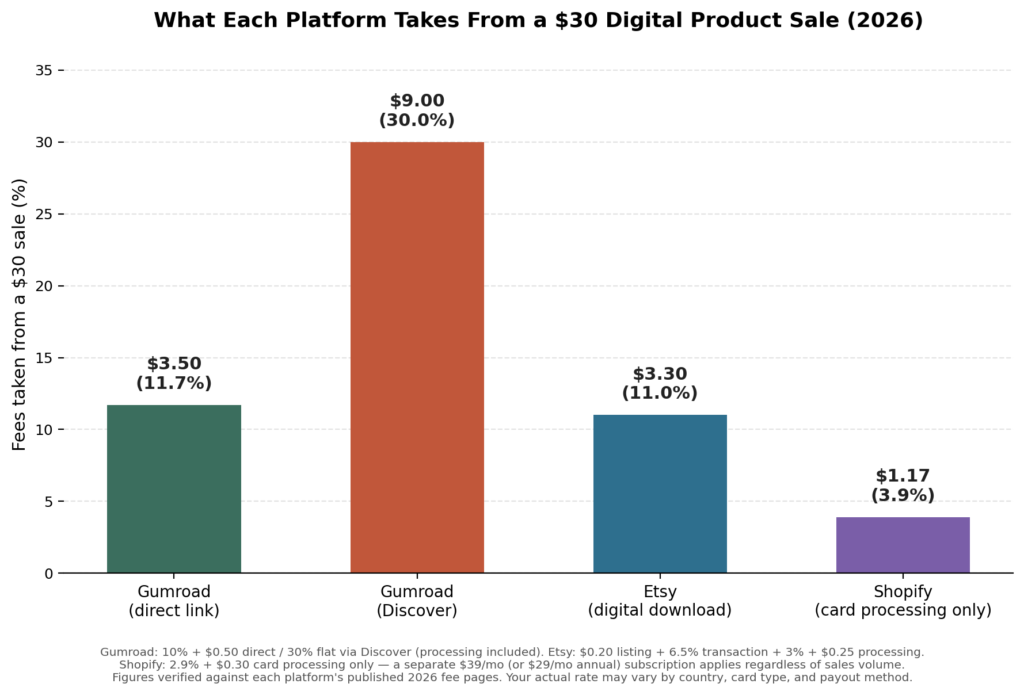
Templates are almost always sold on Etsy, Gumroad, or Creative Market. Etsy wins on built-in search traffic (92M+ active buyers), Gumroad wins on simplicity, and Creative Market sits in between with a curated, design-focused audience but takes a comparable cut. My own experience: my template shop’s first 40 sales came almost entirely from Etsy search; not from any marketing I did, that built-in discovery is the real reason beginners start there despite the higher combined fee.
EBooks and Digital Publications
EBooks remain one of the most accessible digital products to create: no printing costs, instant global delivery, and the ability to use the book itself as a lead magnet toward a higher-priced course or membership. What’s rarely explained clearly is how Amazon’s KDP royalty structure actually works, and it changes your pricing strategy significantly.
KDP Royalty Math: 70% vs. 35%
| Royalty Option | Eligible Price Range | Fee Structure | Example: $4.99 Ebook |
|---|---|---|---|
| 70% royalty | $2.99–$9.99 only | 70% of list price, minus a $0.15/MB delivery fee | ~$3.34 (before delivery fee) |
| 35% royalty | Any price | Flat 35% of list price, no delivery fee | ~$1.75 |
The 70% tier looks like the obvious choice, but the delivery fee quietly erodes it. A 10MB illustrated ebook loses $1.50 off the top before you see a cent, which can turn the “70%” tier into something closer to 50% in practice. Compressing images before upload is one of the few genuinely free ways to protect your margin here.
Selling directly through your own website or Gumroad (typically 89–90% net after a 10% + $0.50 fee) often out-earns KDP per unit; the trade-off is you lose Amazon’s built-in audience and search traffic, which is usually where most first-time ebook sales actually come from.
Memberships and Subscription Services
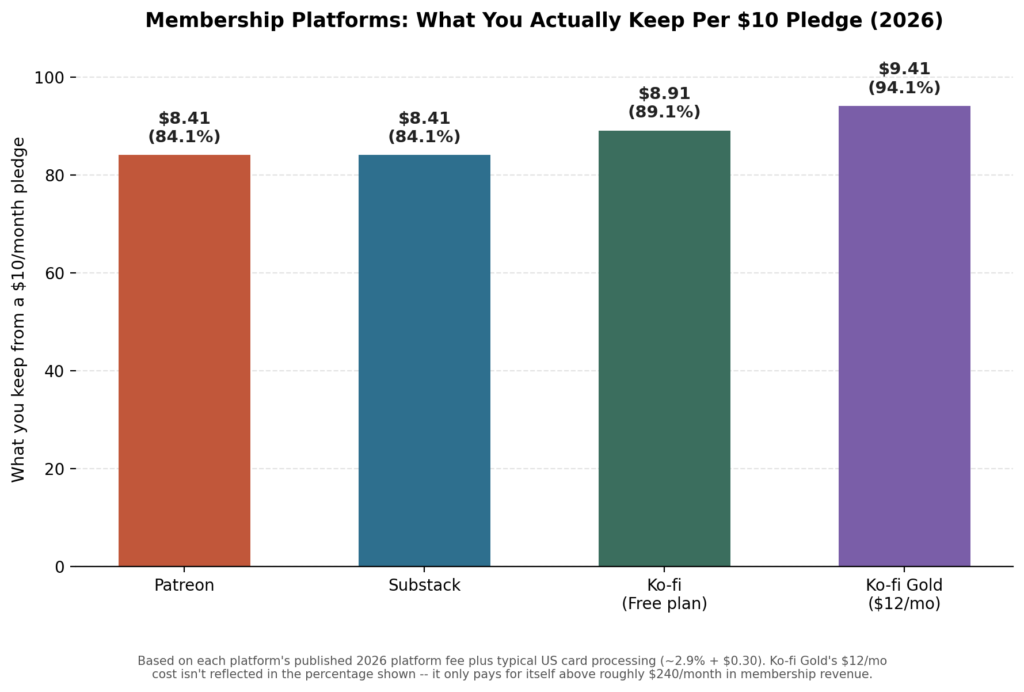
Memberships create the one thing a single product sale can’t: predictable, recurring revenue. The trade-off most people don’t see coming is how much of that recurring revenue the platform keeps because, unlike a one-time sale, a membership fee gets taken every single month, indefinitely.
Membership Platforms Compared (2026)
| Platform | Platform Fee | On a $10/mo Pledge, You Keep | Best For |
|---|---|---|---|
| Patreon | 10% + processing | ~$8.41 (84.1%) | Existing fanbase who already knows the brand |
| Substack | 10% + processing | ~$8.41 (84.1%) | Paid newsletters specifically |
| Ko-fi (Free plan) | 5% + processing | ~$8.91 (89.1%) | Lower-fee alternative with tipping built in |
| Ko-fi Gold ($12/mo) | 0% + processing | ~$9.41 (94.1%)* | Creators earning above ~$240/month, where the flat fee pays for itself |
| Circle | $49–$199/mo flat, 0–4% fee | Varies by plan | Community-first creators who want discussion spaces, not just content delivery |
*Excludes the $12/mo subscription cost, which needs to be earned back before the higher percentage is a net win.
On a $5 pledge instead of $10, these percentages get noticeably worse across every platform, because the fixed processing fee ($0.30) eats a bigger share of a smaller number, a good reason to avoid pricing memberships too low.
My Honest Take: Which Product Type Should You Actually Start With?
If you are choosing your first product and have no existing audience, here’s the ranking I would actually give a friend, based on what worked and didn’t for me:
- Templates first. Lowest time investment, sells on a platform (Etsy) with built-in search traffic, and you find out within a couple of weeks whether the idea has legs.
- Ebook second. Slightly more effort, but you can reuse research from your template niche, and KDP gives you distribution you don’t have to build yourself.
- Course third, only after you’ve validated demand with something smaller. Courses take real time to produce well, and the platforms cost real money every month even before your first sale. I wouldn’t build one on spec.
- Membership last. Recurring revenue is the goal everyone wants, but it only works once you already have people who trust you enough to pay monthly, which usually means you have already sold them something else first.
- Software/SaaS is its own path, not really a “start here” option; it usually requires either technical skills or a technical co-founder, and a genuinely different go-to-market motion than the other four.
Common Mistakes Sellers Make Choosing a Product Type
- Picking a category because it’s trendy, not because it fits the audience they already have. A membership only works if you already have engaged followers; launching one cold rarely works, regardless of platform.
- Ignoring platform fees until after the first sale. The gap between a 0%-fee and a 10%-fee platform is easy to ignore on paper and very easy to notice on your first payout.
- Assuming ebook royalties are simple. The 70%/35% KDP split has enough conditions attached (price range, file size, territory) that many first-time authors earn less than they expected on their first release.
- Underestimating how much a course costs to run monthly, not just to build. A $29/mo platform with a 7.5% transaction fee can end up costing more than a $99/mo platform with none, depending on your sales volume.
- Building a SaaS tool without deciding on tax handling up front. Retrofitting a merchant-of-record setup after you already have paying customers in a dozen countries is far more painful than choosing one before launch.
Conclusion: Why You Should Consider Selling Digital Products
Digital products offer real scalability, low overhead, fast delivery, and the flexibility to tailor an offer to almost any audience. But “what you sell” only matters once you’ve also decided “where you sell it” because the platform’s fee structure is effectively a second, hidden ingredient in your pricing decision from day one.
In 2026, the best digital products to sell online are still the ones that solve a specific, visible problem for a specific person. Pick a category, check the real numbers for the platform you are considering, and build the simplest version that actually helps someone; the rest tends to follow from there.
FAQs: How to Sell Digital Products Online in 2026?
1. Which digital product category has the lowest barrier to entry?
Templates, generally. They require the least production time, sell well on marketplaces with existing search traffic (Etsy), and let you validate an idea in days rather than weeks.
2. Which category earns the highest margin per sale?
Software/SaaS subscriptions typically have the best long-term margins once built, because recurring billing compounds, but they also require the most upfront technical investment and the longest time to profitability.
3. Do I need a large following to sell a membership successfully?
Not a large one, but you generally need an existing, engaged one. Memberships tend to convert best from people who already trust you from another product or platform, rather than cold traffic.
4. Is Amazon KDP still the best place to sell an ebook in 2026?
It’s the best place for discovery; Amazon dominates ebook search traffic but not necessarily the best per-unit payout. Selling directly (your own site or Gumroad) usually nets a higher percentage per sale; the trade-off is you have to bring your own readers.
About the Author
Emily Carter is a freelance writer and digital productivity researcher based in the United States. Over the past four years, she’s tested and written about the tools, apps, and platforms that freelancers and remote workers rely on daily, from security software like password managers to the AI tools and side-income platforms that make up the modern freelance toolkit. She writes from firsthand use, not press releases.