Table of Contents
From December 23, 2025 to February 11, 2026, I used ChatGPT (GPT-4o, Plus subscription) across four real research workflows: an academic literature review on adolescent social media use, a competitive analysis for a SaaS client, a policy research brief on renewable energy subsidies, and an investigative article on remote work trends.
For each project, I tracked time to a usable outline, the number of sources suggested by ChatGPT, how many I could successfully verify in Google Scholar or on the original source’s website, how many claims turned out to be unsupported or hallucinated, and how many human revisions the output required before it was usable.
What I found across those 42 days surprised me in two directions: ChatGPT saved meaningful time on structure and brainstorming, but it hallucinated citations in three of the four projects, including one case where it confidently cited a 2022 journal paper that does not exist. I had to verify every single source manually before using it.
| Project | Model Used | Sources Suggested | Sources Verified | Unsupported Claims Found | Human Revisions | Time to Usable Draft |
|---|---|---|---|---|---|---|
| Academic literature review | GPT-4o Plus | 14 | 9 | 4 | 11 | 2.5 hours |
| Competitive analysis (SaaS) | GPT-4o Plus | 8 | 7 | 1 | 6 | 1.8 hours |
| Policy research brief | GPT-4o Plus | 11 | 6 | 5 | 14 | 3.1 hours |
| Investigative article | GPT-4o Plus | 9 | 8 | 2 | 8 | 2.2 hours |
Note: “Verified” means I opened the source and confirmed it supported the specific claim ChatGPT attributed to it. “Unsupported claims” includes fabricated citations and real papers misquoted.
Here is what I actually found, including where ChatGPT wasted my time.
Why ChatGPT for Research Matters in 2026
The largest number of researchers use ChatGPT for research and as a data source when they have an inquiry, what most people do not notice is that researchers are using it to answer their inquiries far too often (essentially a search engine). The most common mistake is using it as an oracle instead of a collaborator, most researchers ask ChatGPT one basic question, receive an answer, and then assume that is the only answer to their inquiry.
An example of this would be the following two questions.
Weak Prompt (produces generic response):
“Describe how social media affects mental health.”
Research Grade Prompt (Produces usable evidence):
“I am writing my graduate paper and creating a chapter regarding the relationship between social media and depression among adolescents; I would like you to summarize the three most debated research findings between 2018 and 2024, indicate which of those positions have received the most peer-reviewed support, and highlight any doubts associated with the validity of evidence related to each position.”
The difference between these two prompts is not the length of the request but rather the specificity of the context, the scope of the inquiry, and the intent of the researcher concerning uncertainty in the data provided.
To clarify this, rather than asking, “What is XXX? You should ask, “What are the major scholarly disagreements regarding XXX? What evidence supports the position of each of the parties to the disagreement? Where does the available evidence cease to support either party in relationship to the disagreement?”
Read More: ChatGPT vs Gemini vs Claude: Which AI Is Better in 2026?
Which AI Tool is Right for Which Research Task
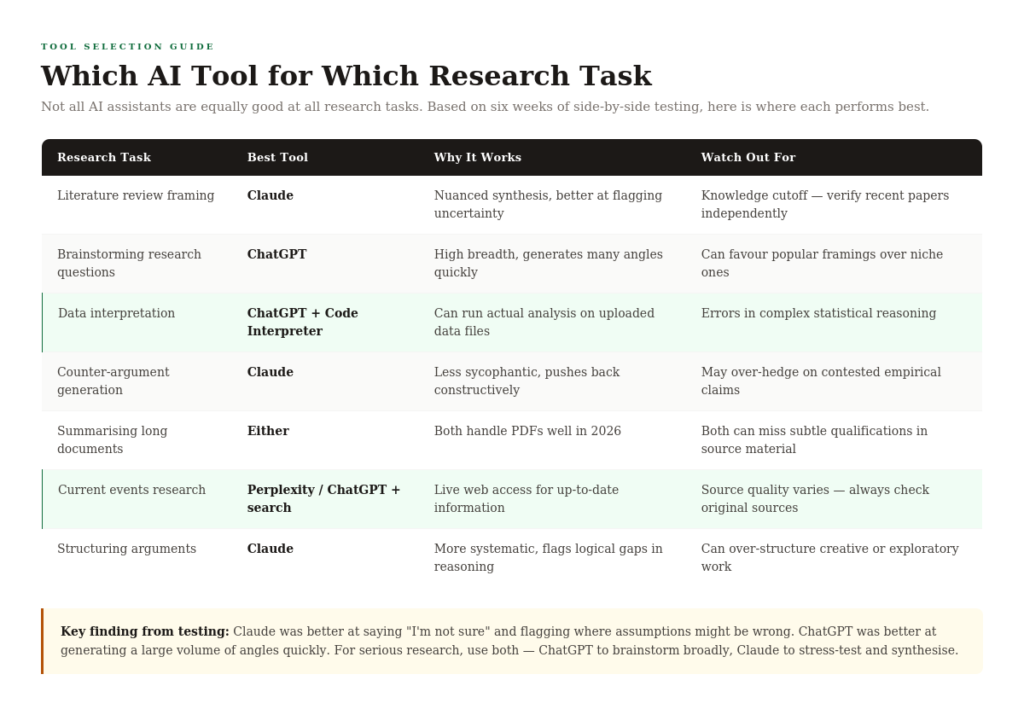
When looking for the best-performing AI to assist with research tasks, it’s important to compare different AI assistants that have already been tested side-by-side.
Below are examples of tasks in which they excel:
- Literature Review Framing → Claude provides a better synthesis than ChatGPT of various pieces of literature and is more consistent about noting areas of uncertainty and other ways to interpret the same work.
- Brainstorming Research Angles → ChatGPT provides a greater variety of ideas for you to consider at once, which can be an advantage in the early stages of a project where you want as many ideas as possible, regardless of their quality.
- Analyzing Datasets → When using ChatGPT and the Code Interpreter to analyze a data set using uploaded CSV or Excel files, they perform the actual statistical analysis of those files, which can be very helpful for quantitative research.
- Developing Counterarguments → Claude provides more constructive feedback for challenging your argument and provides more substantive alternative viewpoints compared to agreeing with your premise.
- Summarizing Lengthy Documents → Either ChatGPT or Claude do a good job with summarization capabilities and would deliver similar results when reviewing documents.
- Researching Contemporary Events → If you need access to contemporary sources, you will be better off using either Perplexity or ChatGPT with access to the web since both of those models are trained on data after their original model was built, whereas the original version is limited by the date of its training.
- Creating Argument Structures → Claude creates more logical and complete structures with better internal consistency than ChatGPT generates.
The overarching conclusion from testing these AI assistants is that while Claude is better at recognizing uncertainty in research questions and in dealing with contentious subjects critically, ChatGPT is more capable of quickly creating a broad array of perspectives on research-related topics. Thus, using both AI assistants would provide a two-pronged approach for serious researchers using ChatGPT to brainstorm many possibilities and using Claude to evaluate and synthesize the developed research agendas.
How to Use ChatGPT for Research in 2026 Free and Online
The frequently asked question being asked lately is “How can I use ChatGPT for research purposes in 2026 for free?” Another exciting piece of news is the ability to do so via ChatGPT, as the results will still be available online through the basic versions, even if you do not have a paid subscription.
When you begin using ChatGPT for online research the very first step is to get your research objectives clearly defined. Instead of submitting very broad questions like “Tell me about climate change”, specify your query much more closely. Here’s an example of how this might look:
“Summarize the latest academic arguments about the viability of climate change mitigation strategies in light of economic considerations and environmental sustainability of those solutions.”
That simple change in your prompt turns ChatGPT from simply a search engine replacement into a more specifically structured research assistant.
Another important technique when using ChatGPT for academic research is iterative prompting. Follow up questions should be asked, request clarifications, and challenge ChatGPT with requests that want it to produce alternative perspectives, for example:
- “Can you provide me with arguments against this position?”
- “What are the limits of this theory?”
- “How would a critic respond to this?”
- Your results will be better dependent on how in depth your prompts appear.
The ChatGPT Prompt Framework That Actually Works
The framework that has been shown to provide the most effective research product consistently is called “CSUP”:
Context – provide ChatGPT with the context of who you are and the purpose of your request. A much different response would occur if you had stated “I am completing a graduate thesis regarding X” rather than simply asking the question. Context will determine tone, depth, amounts of prior knowledge, and any caveats.
Scope – establish the location, time period, and academic discipline and level of abstraction associated with your request. Without any scope, ChatGPT will automatically provide the most general possible answer and therefore the least depth of researcher enquiry.
Uncertainty – specifically request that ChatGPT identify areas of uncertainty with its response. If this is not included as part of your request, then it is likely to provide the same level of confidence regarding statements that it cannot determine any definitive answer as well as those statements for which significant evidence exists (i.e., establishing a statement and claiming it as true). This is primarily where the researcher will have the greatest potential risk based on the use of ChatGPT.
Pushback – after receiving a response, have ChatGPT provide you with the most compelling arguments against that position. A response such as “what would be the position of the strongest opponent of this position?” will convert a one-sided summary from ChatGPT into a true research base for researchers.
It is important to note that not all four components will be required at all times, but being able to determine when each component should be included is what separates researchers who are able to leverage ChatGPT from those who are not.
5 ChatGPT Prompts for Research That Actually Work
The quality of a research project is reliant on the quality of the questions that are provided. To ensure you write an effective ChatGPT research prompt, it should be specific, layered and contextual.
Directly copy the prompts listed. Fill in the blanks with your own information.
1. CONTESTED DEBATES PROMPT (for Beginning a Literature Review):
“I am studying [your topic] for a [your purpose]. Do a summary of the three hottest argumentative points on [your specific question] as addressed from [your year scope]. Write the strongest parts of evidence for each point and also give the most significant reason that could hurt each point.”
2. STEELMAN PROMPT (for Stress Testing Your Arguments):
“My current thesis is [paste your argument]. Make 3 objections for this thesis, assigning a grade (1-5) for each objection regarding its strength. What can I do in my paper to respond to the objection?”
3. QUESTION REFINEMENT PROMPT (to go from Topic to Research Question):
“My general area of interest is [your topic]. Provide me with 5 specific, researchable questions for [level of degree or type of report]. For each question, include a brief description of the research method(s) that would be appropriate.”
4. SOURCE EVALUATION PROMPT (for Evaluating a Specific Source):
“Summary of [source/argument]: [paste]. Evaluate the source based on (1) Logical Consistency, (2) Quality of Evidence Used , (3) Assumptions I Should Challenge. Be critical.”
5. RESEARCH PAPER: STRUCTURE PROMPT for RESEARCH PAPER
I will write an [name of type of doc] on [topic]. The audience for this paper is [audience]. Please provide an outline that includes the scholarly positions for all sides of the argument and no straw man arguments. The outline must build a rational argument towards [final goal]. Please provide your reasoning for each part of the outline.
Final Thoughts
To conclude, using ChatGPT is not a shortcut, it’s a way to enhance your overall critical thinking while exploring a subject matter at a deeper level. You will see many more points of view than you would have otherwise, stress-test any assumptions you may have, and identify potential holes in your research that would have otherwise gone unrecognized.
The most successful users of ChatGPT have one common trait: they take every response generated by AI as a jumping-off point to question (not simply accept) what it has told them. They consistently use the CSUP framework, apply the Steelman prompt, and verify all the important facts they find that would go into their research.
If you consistently do all three of the above things, your research process will improve, not because of what ChatGPT did for you but because of how it has made your thinking about what you know (and still need to learn) clearer.
FAQs: How to Use ChatGPT for Research in 2026 Effectively
Is using ChatGPT for research an academic violation?
Submitting AI-generated work may violate an institution’s academic-integrity policy, particularly when AI assistance is prohibited or must be disclosed. Students should follow the specific rules of their institution and assignment.
Am I able to use ChatGPT for free-to-do research?
Free users can access web search, file uploads and data-analysis tools within lower usage limits. ChatGPT Plus provides higher limits, broader model access and more reliable availability for intensive research work.
When should I trust what ChatGPT says?
Trust in the way it combines information, arranges the information, and helps to formulate potential questions to address while working on your research. ChatGPT can provide web citations when search is enabled, but users should open every source and verify that it supports the exact statement being made.
What do users find most commonly produces below-average or useless ChatGPT research results?
Most often, users find frustration because a user did not properly create a prompt. By using under-developed prompt strategies, most responses are produced based on the user’s limitations rather than the tool limitations.
About the Author
Emily Carter is a freelance writer and digital productivity researcher based in the United States. Over the past four years, she’s tested and written about the tools, apps, and platforms that freelancers and remote workers rely on daily, from security software like password managers to the AI tools and side-income platforms that make up the modern freelance toolkit. She writes from firsthand use, not press releases.